


NBDO workshop a success- October 12, 2003
POSTED BY: Eurobasket Center
Follow us on


"When we talk about sport development, in my case basketball, we are not only talking about basketball on the court, but also taking into account the administrative aspects, which help to put our aims and goals into a more clear track for everyone to follow. The two week course in Coffs Harbour in Australia, held at the FIBA Oceania headquarters, targeted three main objectives," said Pierre Izono, Vanuatu's participant at the workshop. "The first part of this workshop was to review our individual work progress over the last three years. The second agendum was to look into the case of newly established NBDOs in the region and how our experience could help them get started in their own countries. And the final objective as mentioned before, was to find out ways to improve our work as NBDOs. There were 13 participants from Northern Marianas, Yap, Palau, Kiribati, Fiji, Tonga, PNG and Vanuatu. The workshop took place between the 8th - 21st September 2003. In the workshop we covered strategic planning, marketing, computerised databases, talent identification programmes, a review of regional tournaments such as SPG etc., the role of NBDOs in the community, what to do in school holidays, the preparation of international events and use of the media. Most of the workshop dealt mainly with theory, except for the school programmes in which we had the opportunity to gain practice in organising competitions for schools situated around the FIBA Oceania headquarters. One of the most important item on the agenda, to Vanuatu, was the identification of talent programme," according to Pierre. The whole aim of every sport discipline is to improve the performance of athletes as a whole. It is thus important to set up a good system to achieve this target. We had the chance to go through how Australia carries out its ID programme, and how we could adapt this programme into our environment here in Vanuatu. They start at primary school level, continue on to representative level, move to elite level and then to professional level. Here we start with primary schools, where participation is huge. Responsibility-wise, we have teachers to give a hand; then we move to secondary, then we move to provincial school games, then we move on to provincial games before stepping out into the elite programme for national reps. But our main problem here is the fact that there are not enough volunteers helping out in sport arenas, unlike in Australia. That is why we have to concentrate more on school programmes where teachers can become useful aides to developping sports. What happens in Australia, is that coaches responsible for different levels identify players and propose them to the next level coaches. By comparison, here we can use teachers for the same task in identifying potential players and proposing them to the national coaches for further follow up, for example at the provincial or national level. We separate into groups to visit schools. Teachers pick their best students and send them to us for training. Not only students who are already familier with the sport; the majority are totaly new to basketball, which shows how dedicated these teachers are to getting as many kids as possible into this sport." "Whether what I have learned is of worth to us here in Vanuatu depends a lot on the support we get from the national federation in terms of finance toward the development of basketball at the junior or school level," stressed Mr. Izono by way of conclusion. |
 VMF are 2024 Opening Tournament Champions (Photo:PortVilaBasketballLeague)
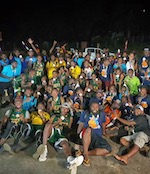 Shefa brings the gold back home at the Tafea 2019 Provincial Games (Photo:vanuatubasketball.com)
